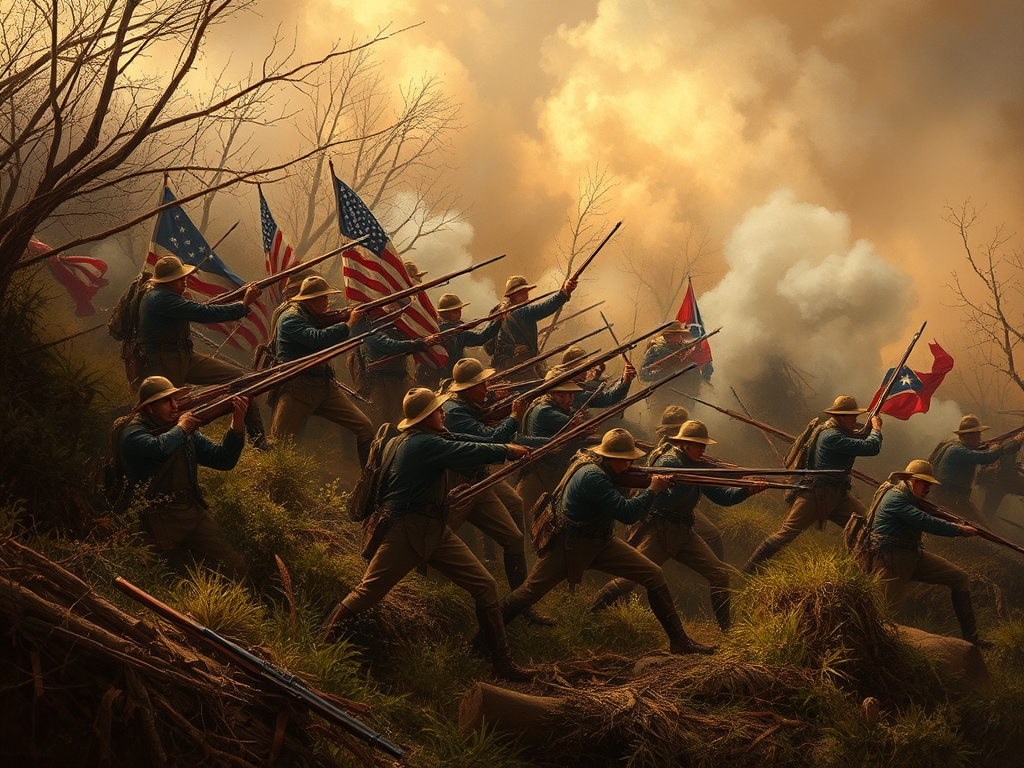
The Opening of Grant’s Overland Campaign
On March 9, 1864, Ulysses S. Grant was promoted to lieutenant general and placed in command of all Union armies. Almost immediately, he began shaping a new strategy aimed at defeating Robert E. Lee’s Army of Northern Virginia and capturing Richmond. This plan would become known as the Overland Campaign.
For the first time in the war, the Union coordinated its major armies in a synchronized offensive. As William T. Sherman advanced toward Atlanta, Grant and George G. Meade would push directly toward Lee, while Benjamin Butler and Franz Sigel launched supporting operations. Grant intended for the Army of the Potomac to keep pressing the Confederates relentlessly fighting until something finally broke.
Crossing the Rapidan and Entering the Wilderness
Grant began the campaign camped north of the Rapidan River. With 115,000 men, he crossed the river unopposed. His goal, much like Joseph Hooker’s at nearby Chancellorsville the year before, was to force Lee out of his fortified positions. But Grant’s long supply train lagged behind, and on March 4 he halted the march to let it close the gap. That pause left his army tangled in the dense, unforgiving terrain of the Wilderness.
Grant positioned his forces along the Orange–Fredericksburg Turnpike and the Orange Plank Road—routes he expected Lee to use.
May 5: The Battle Erupts
At dawn on May 5, Confederate General Richard Ewell’s corps, moving along the turnpike, collided with Gouverneur Warren’s V Corps. Fighting escalated quickly. Grant rushed John Sedgwick’s corps forward and ordered Winfield Scott Hancock’s troops—already ahead of the main army—to double back.
Lee, though outnumbered, had no intention of letting the Union army escape the Wilderness without a brutal fight.
Confederate Countermoves
Lee planned to strike with two corps advancing on parallel roads:
- Ewell on the turnpike
- A.P. Hill on the Orange Plank Road
Both would hit the Union army at right angles to its line of march. Lee hoped to delay major action until James Longstreet’s corps arrived, but the intensity of the Union attacks forced his hand. - Brigadier General Charles Griffin pushed Ewell’s men back, but the thick underbrush caused confusion and exposed Union flanks. Ewell counterattacked, regained lost ground, and—still under orders to avoid a full engagement—dug in to wait for Longstreet.
- On the Plank Road, A.P. Hill faced Hancock’s aggressive assault. The fighting seesawed violently until nightfall, with the dry woods catching fire and filling the battlefield with choking smoke.
May 6: Longstreet Arrives
At 5 a.m. on May 6, Grant renewed the offensive. Ewell’s corps suffered heavy losses but held the turnpike. On the Plank Road, Hancock’s attack nearly shattered Hill’s exhausted troops—until Longstreet’s corps arrived dramatically on the field. - Rallied by Lee himself, Longstreet’s men slammed into the Union left, exploiting a gap and driving the Federals back. Union General James Wadsworth was mortally wounded in the chaos. Moments later, Longstreet was accidentally shot by his own men, abruptly halting the Confederate momentum. Lee paused to reorganize.
Burnside Enters the Fight
Ambrose Burnside’s IX Corps soon attacked, breaking the lull. Lee stabilized his lines and pushed Burnside back toward the Union breastworks along Brock Road. Those log defenses caught fire, and the flames briefly helped the Confederates drive the Federals out. But fresh Union reinforcements arrived and ultimately forced the Confederates back for good.
Aftermath
By the next day, the fighting had ceased. Both armies rested amid staggering losses: Grant had lost more than 17,500 men, Lee around 8,000—numbers reminiscent of Chancellorsville. But this time, the Union army did not retreat across the Rapidan. - Instead, Grant ordered the army to march south. When the troops realized they were advancing rather than withdrawing, cheers erupted. The Overland Campaign—and a new, relentless phase of the war—had begun.


